
The complete guide
What is Sage Intacct? The complete South African guide
Sage Intacct is a cloud-native financial management platform built for mid-market organisations — companies that have outgrown small-business accounting tools like QuickBooks, Xero, or Pastel, but don't need the weight of a large-enterprise ERP like SAP or Oracle. It is the preferred financial application of the AICPA, ranks consistently as a leader in cloud financial management, and is the platform we implement at Bo Gartner.
This guide is written for South African finance leaders evaluating whether Sage Intacct is the right next move. It is comprehensive on purpose — what the product is, who it's for, the architecture that makes it different, how it handles SARS / IFRS / FICA / POPIA / B-BBEE, what it costs in ZAR, and how implementations actually run in practice.
01 · Definition
What Sage Intacct is, in one paragraph
Sage Intacct is a cloud accounting and financial management platform owned by The Sage Group plc. It provides a multi-entity, multi-currency, dimensionally-tagged general ledger; accounts payable and receivable; cash management; order and inventory management; project accounting; revenue recognition; budgeting and planning; and a rich API for connecting to the rest of your business stack. It is delivered as software-as-a-service — your finance team logs in through a browser, your data lives in Sage's cloud, and Sage releases four product updates a year.
Its differentiator is architectural. The general ledger is dimensional — every transaction can be tagged with structured metadata like entity, location, department, project, customer, vendor, item, or any custom dimension you define. Reporting then slices on any combination of dimensions on demand. This is the feature that makes Sage Intacct fundamentally different from QuickBooks, Xero, or Pastel.
02 · History
Where Sage Intacct came from
Intacct (originally Intacct Corporation) was founded in 1999 in San Jose, California, and was one of the earliest pure-cloud accounting platforms. It served the US mid-market for nearly two decades as an independent company before being acquired by The Sage Group plc in 2017 for roughly USD 850 million — at the time, Sage's largest-ever acquisition. The acquisition was part of Sage's strategic shift away from on-premise software toward cloud-native subscription products.
Since the acquisition, Sage has invested heavily in Sage Intacct: expanded geographic reach (UK, Ireland, South Africa, Australia, Canada, France, Germany, and the SADC region), accelerated module development, deeper integrations with Salesforce and the wider Sage product family, and tighter native support for industry-specific frameworks (ASC 606 / IFRS 15 revenue recognition, healthcare, professional services, non-profit, financial services).
Sage Intacct is the only cloud financial management solution endorsed by the AICPA (American Institute of Certified Public Accountants). It consistently ranks as a leader in G2 and Gartner reviews of cloud financial management software, and is the platform most US-based fast-growth SaaS, professional services, and non-profit organisations adopt when they move off QuickBooks.
03 · Audience
Who Sage Intacct is built for
Sage Intacct is purpose-built for the mid-market. In a South African context, that typically means:
- Annual revenue between R100 million and R5 billion (the most common band; some smaller organisations choose Intacct when complexity is high).
- Multiple legal entities — anything from two to several dozen — often across more than one currency or jurisdiction.
- A finance team that already feels the pain of running month-end in Excel and is starting to make material errors because of it.
- Regulatory exposure (SARS, IFRS, FICA, POPIA, industry-specific frameworks) where audit trail, controls, and statutory reporting matter.
- A growth trajectory that includes adding entities, raising capital, going through M&A, or scaling internationally.
The strongest signal that a South African organisation is ready for Sage Intacct is when month-end close routinely takes more than ten business days, when consolidated reporting requires more than half a day of spreadsheet work, or when the auditor's questions are getting harder to answer from the system as it is.
04 · Honest contraindications
Where Sage Intacct is the wrong answer
Sage Intacct is not for everyone. There are organisations for whom it is honestly the wrong choice — and admitting that builds the trust that comes back as a referral years later. We won't sell you Intacct if you fit any of the following:
- Single-entity small business under R50 million revenue. Pastel Partner, Xero, or QuickBooks Online will serve you well at lower cost and complexity. Migration to Intacct is justified by complexity, not size.
- Heavy point-of-sale or e-commerce-first operations. Sage Intacct is a financial management platform, not a retail ERP. If your day-to-day is barcoded retail, you want something different (and likely an inventory-led system that integrates to Intacct rather than replaces it).
- Manufacturing with deep shop-floor execution requirements. Sage Intacct handles cost accounting well, but does not run MES, MRP-II, or floor scheduling. Pair it with a manufacturing system if you need that.
- Very large enterprise with bespoke regulatory and operational complexity. Listed groups above ~R10 billion revenue with sector-specific operations (oil & gas, mining at scale, banking core systems) typically need SAP S/4HANA or Oracle Fusion. Sage Intacct can be part of that landscape but rarely the core.
If you are at the lower or upper edge of these bands, talk to us anyway. The decision is rarely cut-and-dried, and we'd rather have an honest two-hour conversation than a wrong implementation.
05 · The architectural difference
What the dimensional GL actually means
The most-cited feature of Sage Intacct is its dimensional general ledger. It is also the one most people misunderstand. Here is what it actually does and why it matters.
In a conventional accounting system — Pastel, QuickBooks, most older ERPs — the chart of accounts is the primary way you classify transactions. Need to know spend by department? You create separate GL accounts for each department-and-category combination. Need to slice by project too? You create accounts for each project-department-category combination. Over time, the chart of accounts balloons to thousands of accounts, each a unique combination of attributes, and the system becomes brittle.
Sage Intacct flips the model. The chart of accounts stays clean and small (typically 100–300 accounts that reflect the natural categories of the business). Each transaction is then tagged with structured dimensions — entity, location, department, project, customer, vendor, item, class, employee, and any custom dimensions you define (B-BBEE category, funder, programme, segment, division). Reports query across the dimensions on demand: "show me operating expenses by department by project for entity X" is a one-line filter, not a custom report build.
The practical effect for South African finance teams: you stop maintaining 3,000-line charts of accounts that nobody fully understands. You design six to eight dimensions that reflect how the business actually runs, and your reporting becomes a question of querying rather than rebuilding.
For a deeper dive into how this plays out for a multi-entity SA group, see our multi-entity consolidation playbook.
06 · The product surface
Core modules — what's in the box
Sage Intacct is modular. You licence the modules you need and add more as your organisation grows. The most common module set for South African mid-market customers looks like this:
- General Ledger. The dimensional GL described above. Includes the chart of accounts, journals, allocations, and the consolidation engine.
- Accounts Payable. Supplier records, bills, approval workflows, payment runs, three-way matching against purchase orders.
- Accounts Receivable. Customer records, invoicing, statements, ageing, collections.
- Cash Management. Bank account configuration, deposits, transfers, reconciliations, and bank feed integration.
- Order Management. Quotes, sales orders, fulfilment, returns, customer pricing.
- Inventory Management. Item master, multi-warehouse stock, costing methods (FIFO, weighted average, standard), valuation.
- Project Accounting. Projects, tasks, resources, budgets, project-level revenue and cost, project profitability — essential for professional services firms.
- Time & Expense. Employee time entry, expense capture, reimbursement, and feed into Project Accounting or AP.
- Multi-Entity Console. The native multi-entity engine — inter-entity transactions, intercompany matching, consolidation, eliminations, ownership percentages.
- Multi-Currency. Multiple functional currencies per entity, daily / monthly / custom FX rates, FX revaluation, currency translation adjustment (CTA) on consolidation.
- Contract & Revenue Management. ASC 606 / IFRS 15 revenue recognition — essential for SaaS and contract-based businesses.
- Budgeting & Planning. Native FP&A — budgets, forecasts, scenarios, variance reporting.
- Fixed Assets. Asset records, depreciation schedules, tax registers, disposals.
Sage adds new modules and capabilities each release. Bo Gartner reviews the release notes quarterly and surfaces what's worth adopting for our managed-support clients.
07 · The integration surface
How Sage Intacct talks to the rest of your stack
Sage Intacct's value compounds when it integrates with the systems your business already runs. The platform exposes a comprehensive Web Services API (REST and SOAP), and Sage maintains a marketplace of pre-built connectors. The integrations South African mid-market customers most commonly need:
- CRM: Salesforce (native connector — the deepest), HubSpot, Microsoft Dynamics 365 CE.
- Payroll (SA-specific): SimplePay, PaySpace, Sage 300 People, Sage VIP.
- Banking (SA-specific): FNB, Standard Bank, Nedbank, Absa — both payment file generation (EFT, salaries, bulk) and bank statement import.
- Payments: Stripe, Paystack, Yoco, PayFast, Peach Payments.
- Expense management: Expensify, SAP Concur, Bill.com (where available).
- E-commerce: Shopify, WooCommerce via middleware (Celigo, Workato, custom).
- Tax / e-invoicing: Avalara (US), local SA VAT reporting bridges.
- BI / data warehouse: Direct ODBC, Snowflake / BigQuery via ETL connectors.
Where no off-the-shelf connector exists, custom integrations to the Web Services API are routine. Bo Gartner has built and maintained dozens. See our integrations service for the full landscape and current pricing.
08 · Comparison
How Sage Intacct compares to the alternatives
Sage Intacct competes against a small set of clearly-defined alternatives. Here is an honest read on each:
Sage Intacct vs QuickBooks Online
QuickBooks is excellent for small business. It is not built for multi-entity, multi-currency, dimensional reporting, or audit-grade controls at mid-market scale. The transition happens when a QuickBooks-based finance team finds itself doing month-end in Excel because the system has run out of capability.
Sage Intacct vs Xero
Same dynamic as QuickBooks — Xero is excellent for small business and accountant practices, weaker for mid-market complexity. Xero has improved its multi-entity story in recent years but does not match Intacct's dimensional GL or revenue recognition capability.
Sage Intacct vs Pastel Partner / Pastel Evolution
Pastel is the dominant small-business accounting platform in South Africa. It is solid for what it does — single-entity SA accounting, payroll integration, SARS VAT reporting. It is not a multi-entity ERP, has limited dimensional reporting, and was not designed for cloud-native operation. Most SA mid-market migrations to Sage Intacct come off Pastel. See our 90-day migration playbook.
Sage Intacct vs Oracle NetSuite
NetSuite is Sage Intacct's closest competitor in the cloud mid-market segment. NetSuite is broader (it includes CRM, e-commerce, more inventory and operations), Intacct is deeper on finance (better dimensional GL, better revenue recognition, simpler implementation). The honest call: NetSuite for organisations that want a single platform for finance + operations + customer-facing; Intacct for organisations that want a best-of-breed financial platform that integrates with other best-of-breed tools.
Sage Intacct vs SAP Business One
SAP Business One is broader (operations, manufacturing) but heavier and more on-premise-leaning. Intacct is the cloud-native alternative for finance-led mid-market organisations.
Sage Intacct vs Microsoft Dynamics 365 Business Central
Dynamics 365 BC has improved meaningfully in recent years and competes head-to-head in some segments. It is stronger in operations and supply chain; Intacct is stronger in dimensional finance and consolidation. The decision often comes down to the Microsoft 365 / Power Platform integration story versus the Sage Intacct API and Salesforce-first integration story.
For a deeper Sage Intacct vs Xero comparison from a South African angle, see our side-by-side piece.
09 · Local context
Sage Intacct in South Africa
Sage Intacct is a US-headquartered platform with global reach, but works very well for South African finance teams provided it is configured for the SA context. The key local configuration areas:
SARS VAT and VAT 201 reporting
VAT codes in Sage Intacct map cleanly to SARS VAT 201 categories — standard-rated (15%) input and output, zero-rated, exempt, capital goods, imports under s13(1), exports under s11. Every transaction tags one code; the system produces a VAT report that reconciles directly to VAT 201 line items. See our SARS configuration deep-dive for the full setup.
IFRS reporting
IFRS-aligned financial statements come out of the same chart of accounts and dimensional model as the operating books. We configure account groupings, IFRS 8 segments, IFRS 15 revenue recognition, IFRS 16 lease accounting, and statutory financial statement formats so each entity produces local IFRS statements in its functional currency while the group produces consolidated IFRS statements in reporting currency.
FICA + POPIA
FICA documentation lives against customer and supplier records with workflows preventing transactions until verification status is set. POPIA principles map to Sage Intacct's native role-based access control, audit logging, encryption, and configurable retention. See our compliance-design article.
B-BBEE reporting
B-BBEE procurement scorecard reporting becomes a continuous query rather than a quarterly spreadsheet exercise. Supplier B-BBEE attributes (level, ownership %, EME / QSE / Generic status, recognition %) sit as structured fields on the supplier master and propagate to every transaction. See how this works in practice.
Multi-currency consolidation across SADC
For groups operating across South Africa, Zambia, Botswana, Namibia, Zimbabwe, and Mozambique, multi-currency consolidation is core. ZAR + USD + BWP + NAD + ZMW + ZWG + MZN all live natively in the same environment, with automated intercompany, FX revaluation, and CTA on consolidation. See our FX configuration playbook.
10 · Sectors
Industries where Sage Intacct fits naturally
Sage Intacct works well across most South African mid-market sectors. Five we see repeatedly:
- NGO / NPO. Multi-entity, multi-funder, donor reporting, restricted-fund accounting, B-BBEE dimension reporting. The dimensional GL is the killer feature here — slice spend by programme, funder, region, project simultaneously.
- SaaS & technology. ASC 606 / IFRS 15 contract billing, subscription revenue recognition, MRR / ARR / cohort reporting, Salesforce / HubSpot integration, multi-currency for international expansion.
- Professional services. Project accounting, utilisation, billable / non-billable time, blended-rate billing, project profitability — see our Halloran story.
- Financial services. Multi-entity, regulatory reporting, audit-grade controls, IFRS 9 financial instruments classification, deep audit trail.
- Manufacturing & distribution. Cost accounting (FIFO / weighted average / standard), inventory across multiple warehouses, multi-location operations, segment reporting.
Bo Gartner has implemented Sage Intacct across all five sectors in South Africa and the SADC region. Each sector brings characteristic configuration patterns — happy to walk through yours in a scoping conversation.
11 · How it lands
How a Sage Intacct implementation actually works
Sage Intacct implementations are partner-led. Sage itself does not implement; the company maintains a partner network (Bo Gartner is a Premier / Authorised partner) that handles deployment. A typical implementation runs 8 to 14 weeks for SA mid-market customers, longer for complex groups.
Bo Gartner runs every implementation through the Intacct Activation method — a five-phase delivery framework:
- Discover (2 weeks). Map chart of accounts, dimensions, entities, currencies, integration points, reporting requirements, audit posture. Lock the scope and price.
- Configure (4–6 weeks). Build the entity structure, dimensional model, SARS VAT codes, IFRS-aligned reporting templates, approval workflows, AP automation rules in the customer's own environment.
- Migrate (3–4 weeks, overlapping). Trial balance, customers, suppliers, items, open AR/AP, fixed assets, selected historic transactions from the legacy system (Pastel, Sage 50, QuickBooks, Xero). Reconcile and sign off.
- Validate (2–3 weeks). Parallel run, UAT, audit-trail review with finance team and external auditors. No surprises at month-end one.
- Go-Live + Hypercare (cut-over weekend + 90 days). Day-one support through the first close, first audit query, first VAT 201 submission. We're in the room.
For more on the cost side, see what Sage Intacct actually costs in ZAR.
12 · What it costs
Sage Intacct pricing — the honest ZAR view
Sage Intacct is licensed annually based on the modules taken and the number of business users. There is no per-transaction or per-entity charge for the platform itself. Implementation services are quoted separately by your partner.
Indicative annual licensing ranges for SA mid-market customers (these vary year-to-year and depend on Sage's negotiated discount for your scenario):
- Single-entity, 5–10 business users, core modules: ~R250,000 – R400,000 per year.
- Multi-entity (3–5 entities), 10–20 users, multi-currency, full module set: ~R400,000 – R700,000 per year.
- Larger group (10+ entities), 25+ users, with revenue management and planning: ~R700,000+ per year.
Implementation services run separately, typically R350,000 – R1.2 million depending on scope. Ongoing managed support (named consultant, close-cycle SLA, quarterly health checks) typically R10,000 – R40,000 per month.
For a full pricing breakdown including hidden costs, see our cost-in-ZAR article.
Sage Intacct in action
Five organisations, five outcomes
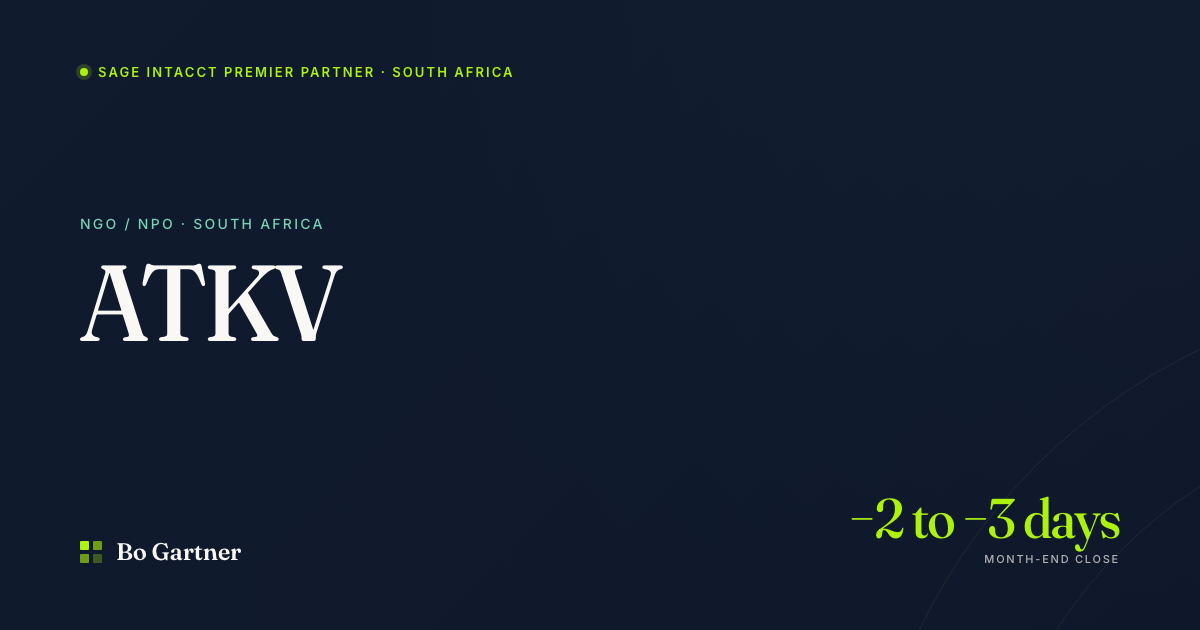
NGO / NPO · South Africa
ATKV
South African non-profit moves from legacy ERP to Sage Intacct, halves month-end close.
Read story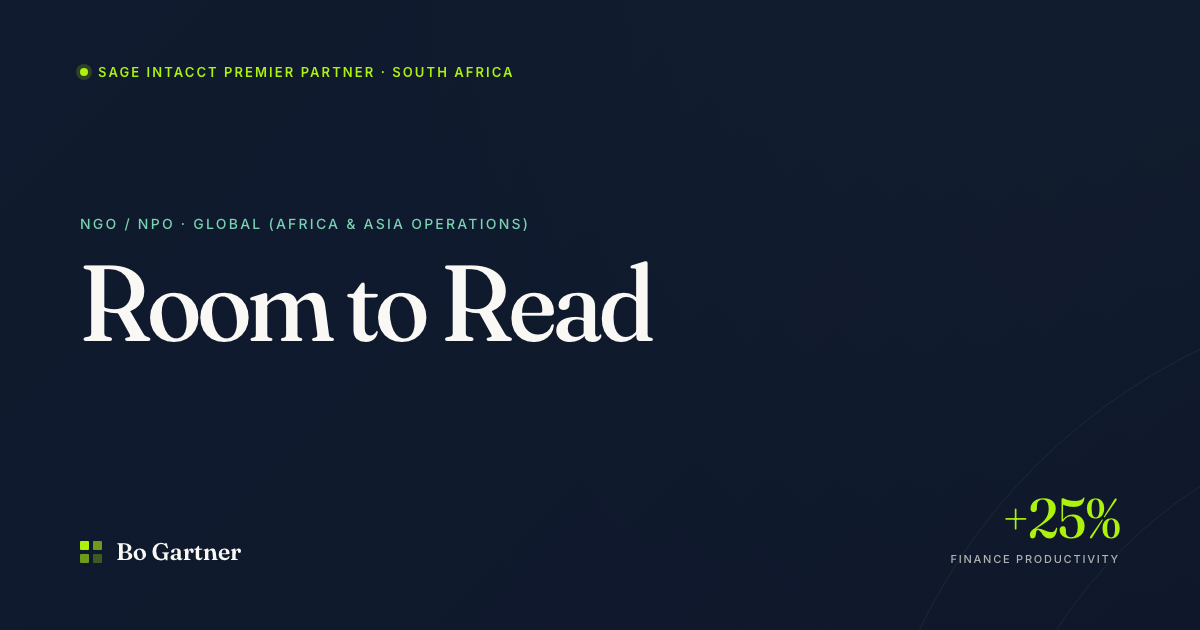
NGO / NPO · Global
Room to Read
Global NGO lifts finance productivity 25% and reaches 121,000 more children with dimensional reporting.
Read story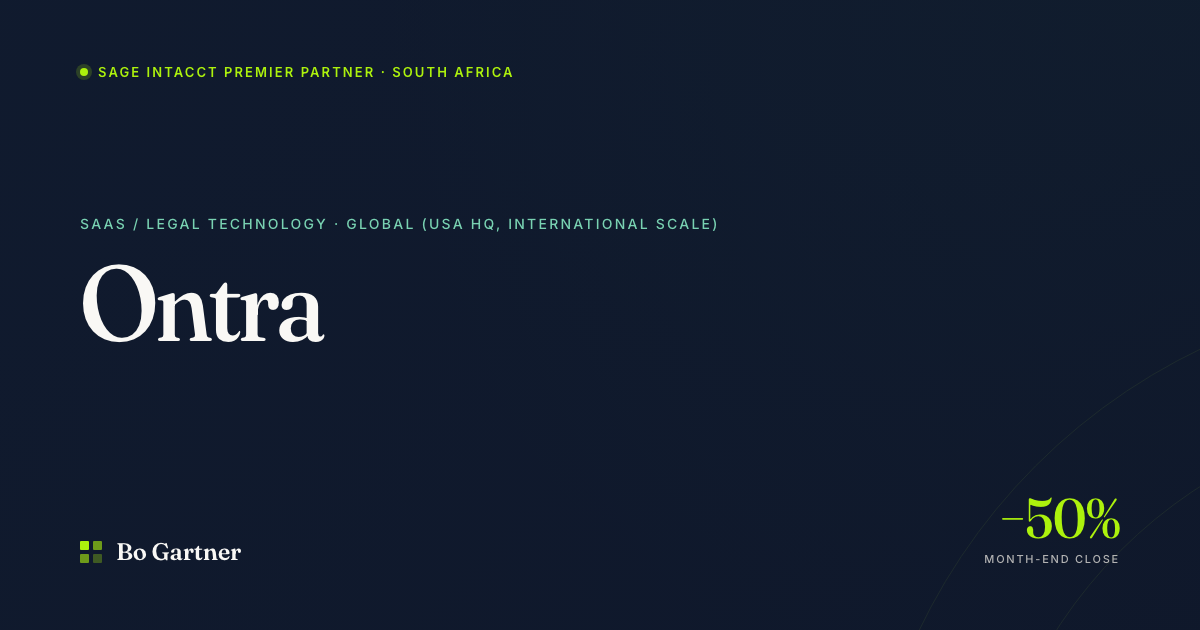
SaaS / Legal Tech
Ontra
Legal-tech SaaS halves its month-end close after moving off Excel.
Read story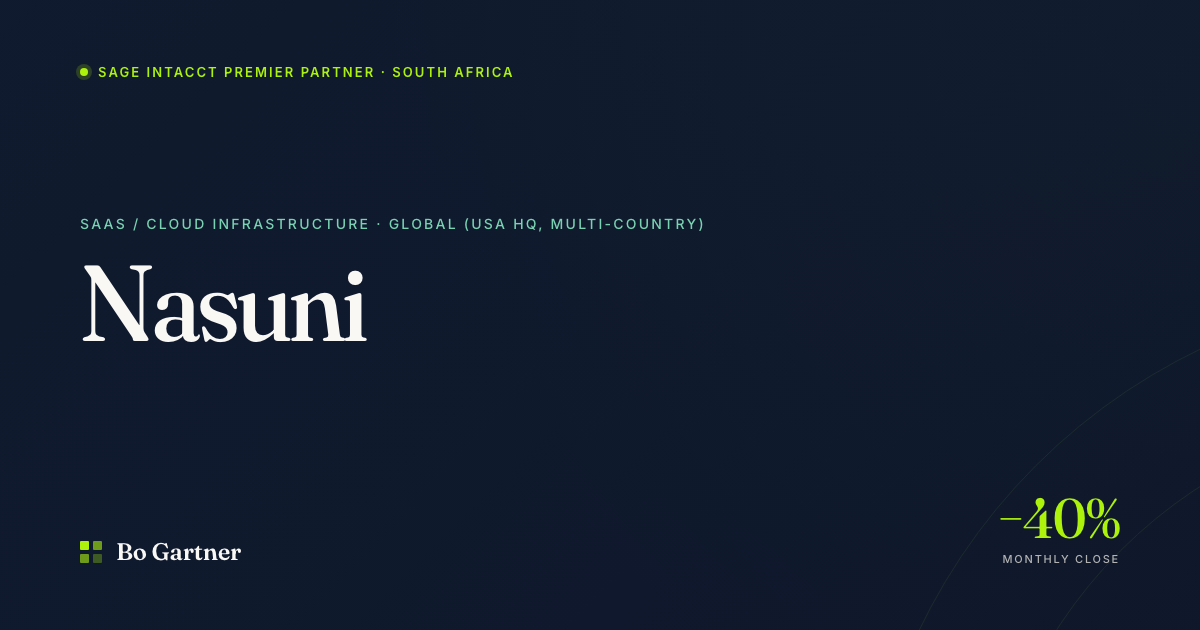
SaaS / Cloud Infrastructure
Nasuni
SaaS firm migrates from QuickBooks to Sage Intacct, raises $25m on the back of cleaner financials.
Read story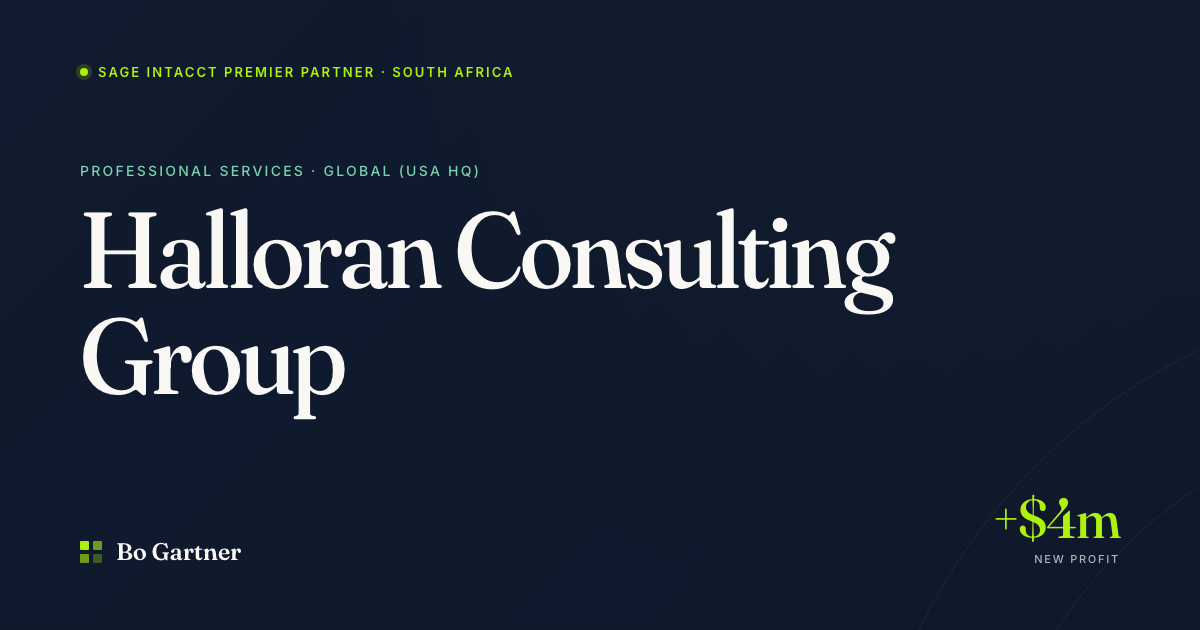
Professional Services
Halloran Consulting Group
Professional services firm adds $4m profit and cuts DSO by 43% with project accounting + revenue recognition.
Read storyDeep dives
Every Sage Intacct topic, organised by cluster
Topic cluster · 01
Multi-entity & multi-currency
Multi-entity
Running a multi-entity South African group on Sage Intacct: the consolidation playbook
Design decisions for SA group implementations — entity model, dimensions, intercompany automation.
Multi-currency
ZAR + USD + multi-jurisdiction: getting FX right in Sage Intacct
FX rate sources, revaluation cadence, IAS 21 CTA configuration.
Intercompany
Intercompany journals at month-end without the spreadsheet panic
Inter-entity AR/AP, recurring allocations, matching reports, eliminations.
Topic cluster · 02
South African compliance
SARS / IFRS
Sage Intacct and SARS: VAT, IFRS, and the South African finance team
VAT 201 mapping, IFRS-aligned reporting, audit-trail design.
FICA / POPIA
FICA, POPIA, and audit trail design in cloud ERP
Customer / supplier onboarding, role-based access, retention, the information officer's job.
B-BBEE
B-BBEE reporting structures inside Sage Intacct dimensions
Supplier B-BBEE attributes, continuous procurement reporting, scorecard preparation.
Topic cluster · 03
Migration & implementation
Migration
Migrating from Pastel, Sage 50, or QuickBooks to Sage Intacct: a 90-day plan
Phase-by-phase migration plan with reconciliation, parallel run, auditor sign-off.
Pricing
What a Sage Intacct implementation actually costs in ZAR
Licensing, implementation services, integrations, ongoing support — honest ZAR ranges.
Topic cluster · 04
Operational depth
AP automation
AP automation in Sage Intacct: from invoice scan to payment file
Bill Capture, three-way matching, approval workflows, SA bank payment files.
Revenue recognition
Revenue recognition (ASC 606 / IFRS 15) inside Sage Intacct for SA SaaS
Performance obligations, ramps, renewals, deferred revenue waterfall.
Frequently asked
17 answers, in plain English
Sage Intacct is a cloud-native financial management platform built for mid-market organisations, with a dimensional general ledger, multi-entity multi-currency consolidation, deep integrations, and a partner-led implementation model.